Why AI characters drift between shots, and the production habits that make a face hold from the first frame to the last.
After 17 years in production and VFX, I have learned that audiences forgive a lot.
They forgive a soft focus pull.
They forgive a slightly hot highlight.
They forgive a cut that lands a few frames late.
What they do not forgive is a face that changes.
The moment your lead looks like a different person in the reverse shot, the story stops. The viewer is no longer watching a character. They are watching a glitch.
In AI video, character consistency is not a nice-to-have. It is the floor.
Why the face drifts
Most video models do not know who your character is.
They know what you described.
And every description is open to interpretation.
"A woman in her thirties with short dark hair" is a thousand different women. Each generation picks one of them.
So the drift usually comes from a few familiar places:
A text-only description doing the work a reference should do.
Different reference images used for different shots.
Wardrobe described loosely, so it shifts with every prompt.
Angles the model has never seen, like a three-quarter back or a low profile.
Lighting changes that the model reads as a change of identity.
None of this is the model being bad.
It is the model being asked to guess.
Lock the character before you shoot anything
On a live-action set, nobody casts the lead on the morning of the shoot.
The same discipline applies here.
Design the character once, approve it, and then treat it as locked.
That means settling three things before a single shot is generated.
The face.
The wardrobe.
The views.
The face is the obvious one. Choose it deliberately, with the same care you would give a casting session. Look at it in soft light and in hard light. Look at it neutral and mid-expression.
Wardrobe is the one people forget. If the jacket is "a brown leather jacket", it will be a different jacket every time. Pin it down: the colour, the collar, the wear on the cuffs, what is under it.
Then the views.
Build a proper turnaround
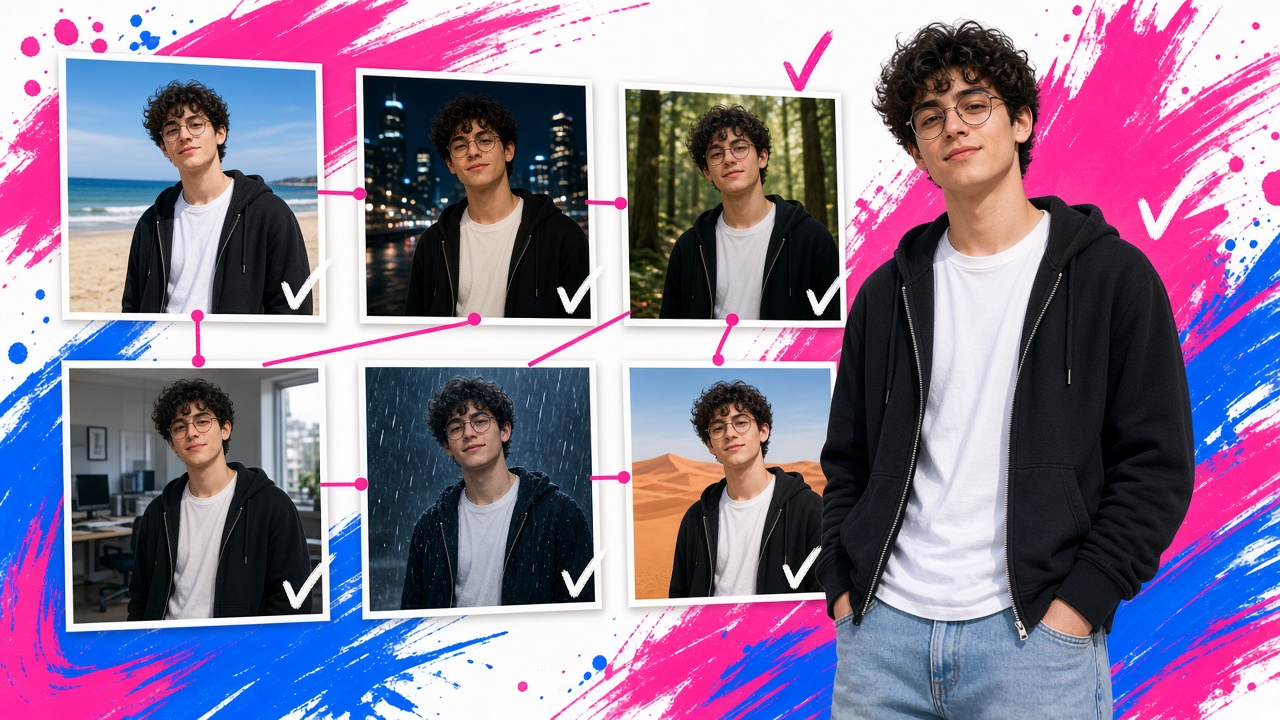
A single hero portrait is not enough.
The model needs to see the character from the angles your camera will actually use.
A practical set looks like this:
Front.
Three-quarter left.
Three-quarter right.
Profile.
Back.
Those five views cover most of what a scene will ask for. When the camera swings around for the reverse, the model is not inventing a new back of the head. It already has one.
A reference prompt for the sheet might read:
Character turnaround, same woman in every panel: front, three-quarter left, three-quarter right, profile, back. Short dark hair with a side part, small scar above the left eyebrow. Worn brown leather jacket, high collar, grey knit underneath. Neutral expression, even studio light, plain grey background.
Even, neutral light matters here.
You want the sheet to describe the person, not a mood.
Carry the same references into every shot
This is where most consistency is won or lost.
Every shot of the character should be built from the same locked references.
Not a similar image.
Not the best frame from yesterday's test.
The same sheet, every time.
When you write the shot prompt, keep the identity language identical across shots and let only the shot language change. The character block stays fixed. The camera, lens, light and action move.
[Character: locked sheet, Mira, leather jacket version] Medium close-up, 50mm, eye level. Mira turns toward the window as the train passes. Cold blue light from frame left, warm practical behind her. Shallow depth of field.
If you rewrite the description of her face in every prompt, you are giving the model permission to reinterpret it.
So don't.
Watch the lighting and the angles
Two things quietly break identity even when the references are right.
Extreme light.
Unfamiliar angles.
Heavy top light, deep shadow or strong coloured gels can reshape a face enough that the model drifts toward someone else. You can still light dramatically. Just check the first take against the sheet before you commit a whole sequence to that look.
Angles work the same way. If your scene needs an overhead or a very low angle, test it early. Those are the shots most likely to come back as a stranger.
Review every take against the reference sheet, not against the previous take.
Comparing take to take lets small drift compound.
Comparing take to sheet keeps it anchored.
Plan for more than one episode
If the project is a series, or a campaign with several spots, consistency has to survive weeks, not minutes.
Keep the locked sheets as a project asset.
Name versions clearly when wardrobe changes on purpose.
Note which reference was used for which shot.
When the character comes back in episode four, you want to pull the exact same face from the shelf, not rebuild it from memory.
This is one of the reasons we built FrameOn
Our team has delivered more than a hundred AI films for clients, with over 30 million views across that work.
Character drift was the problem we kept solving by hand.
So in FrameOn, characters are locked once.
Face, wardrobe and five views.
Then they hold across every shot in the project.
Cue, the production agent inside FrameOn, writes the prompts for each model, so the identity language stays the same whether a shot runs on Seedance, Kling, Veo or another model.
In series mode, the cast stays locked across every episode.
And because every shot is priced before it runs, and nothing generates until you approve it, you are not paying to discover that a face has changed.
The face is the contract
Audiences make a quiet agreement with every character on screen.
This is the person.
Follow them.
Keep that agreement and they will follow you anywhere.
Break it once and they start watching the seams.
Lock the face. Then tell the story.
If this is the kind of workflow you want, FrameOn's early access is open at frameon.us.
— Founder, FrameOn
FrameOn Creativity is yours. The tools are ours. frameon.us