Generating a shot is easy now. Knowing why the shot exists is still the job.
I have spent 17 years in production and VFX.
And the easiest thing to do with AI today is generate an image.
The second easiest thing is to turn that image into a video.
The hard part has not changed.
Knowing what the frame should be. Knowing what the camera should do. Knowing what the actor should do. Knowing why the shot exists.
Beautiful frames, empty films
AI has made visual generation open to almost everyone.
That is a good thing.
But it has created a new problem.
More images and videos are being made than ever, and many of them still feel strangely empty.
Beautiful light.
Slow motion.
Epic camera moves.
And still, the sequence does not feel like a film.
Because visual generation is not direction.
A good AI video does not come from asking a model to "make it cinematic." It comes from making better creative decisions before a single frame is generated.
Stop writing descriptions. Start making decisions.
The natural instinct is to describe what you want.
A woman walking through a futuristic city at night, cinematic, dramatic lighting, shallow depth of field, epic.
You will probably get something impressive.
Now ask the directing questions.
Why is she walking?
Where is she going?
What does she want?
What should the audience feel?
What happens before this shot, and after it?
What should the camera reveal, and what should it hide?
The prompt is only the interface. The better your decisions, the better your generations.
Every shot needs a job
A drone shot looks cool. A slow push-in looks cool.
But a film is not a gallery of cool shots.
A shot might introduce a character, establish geography, reveal or hide information, build suspense, show emotion or end a scene.
Before you generate, ask one question.
What does this shot accomplish?
If the answer is "it looks cinematic," you have not directed it yet.
Same door, three different scenes
Take a man standing outside a closed door.
Fear. The camera stays behind him. We see the door, not his face. His hand slowly reaches for the handle.
Confidence. Low angle. He walks straight toward camera without hesitating. The door fills the background.
Suspense. Start wide and hold still. Something moves behind the frosted glass. He does not notice. The audience does.
Same character. Same door. Same room.
That difference is direction.
Learn the language of the camera
AI video tools give you more camera control every month. Knowing what a control does is not the same as knowing when to use it.
Shot size is a good place to start.
A wide shot gives context. A medium shot gives the character. A close-up gives intimacy. An extreme close-up gives importance.
How close should the audience be to this moment?
Movement works the same way. Instead of:
Camera slowly moves toward the character.
Try:
As he realises what is happening, the camera slowly pushes in, shrinking the space around him.
Now the camera moves because the story needs it, not because the tool can.
Direct the performance, not just the look
A lot of AI filmmaking focuses on appearance. Hair, clothes, face, age.
Actors do not exist to look good. They perform.
Instead of:
A sad man standing in the rain.
Try:
He has just heard terrible news. He tries to stay composed, looks down, takes a breath, almost speaks, then stops himself.
Emotion as an adjective is weak. Emotion shown through behaviour is strong.
And give every character something to do. Not "walks across the room," but walks across the room because they need to reach the phone before someone else does.
Think in beats, not one big prompt
Break the scene into moments.
- Arrival: a character enters an abandoned building.
- Discovery: they notice something unexpected.
- Reaction: they understand what it is.
- Threat: something moves behind them.
- Decision: they turn.
- Reveal: we see what is there.
Each beat gets its own composition, camera, performance and pacing.
You are no longer asking for "a cool video." You are directing a sequence.
Continuity is direction
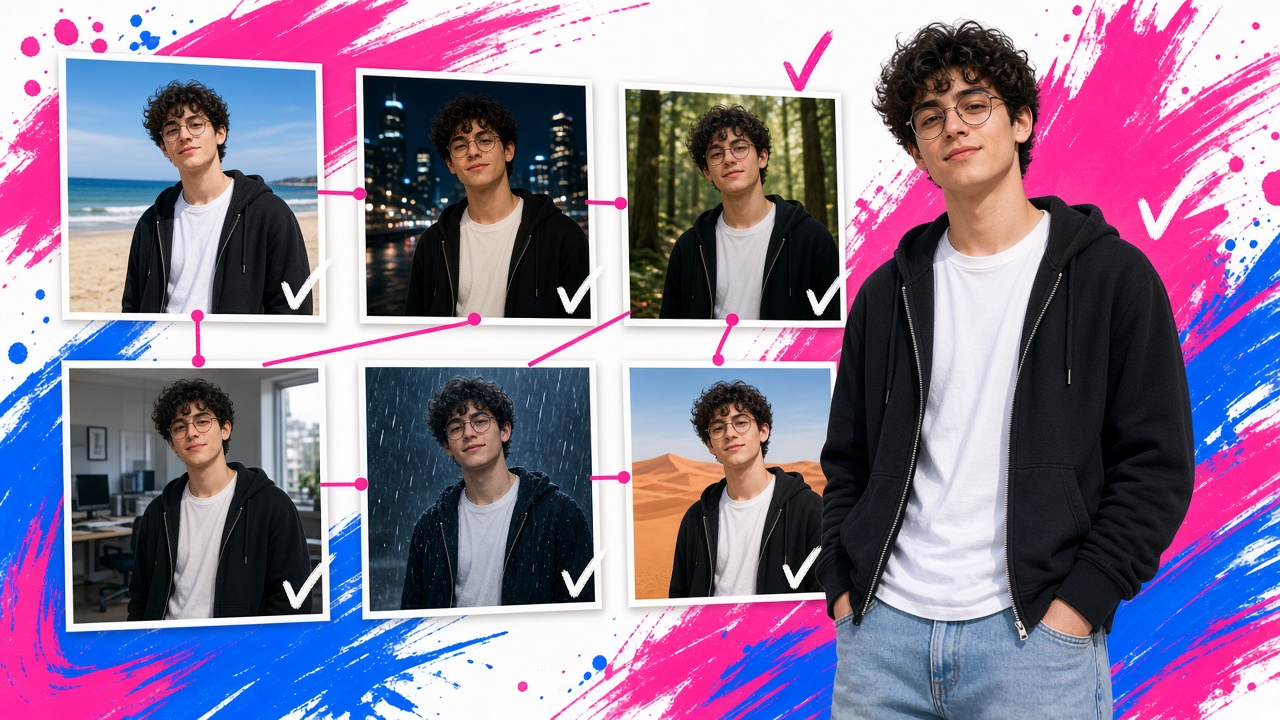
Cup in the right hand. Then the left hand. Then gone. Then the jacket changes. Then the window moves.
Five beautiful generations. One broken scene.
Track identity, wardrobe, props, location, time of day, lighting, screen direction and the emotional state of the character.
Respect the 180-degree line. If your character walks left to right in one shot, flipping them in the next makes the geography feel wrong.
The previous shot is part of the next shot's context.
Light with a reason
"Beautiful cinematic lighting" is not a direction.
Light tells the audience where to look. It sets time and mood. It can hide a face or reveal danger.
The same room can feel safe in warm practical light and clinical under a hard overhead source.
Know why the light is there.
Where FrameOn fits
We built FrameOn as an AI filmmaking platform for filmmakers, studios and brands, around these exact habits.
You can start with a story and shape it into a script and a shot list with Cue, the production agent in the app.
Characters and locations stay locked across shots, so continuity is something you set once instead of fighting every take.
Every shot is priced before it runs, and nothing generates until you approve it.
The tools handle the generation. The direction stays yours.
The tool is not the director
AI will keep getting better at making images move.
It will not decide what your scene is about.
That part was always the job, and it still is.
If you want to try directing this way, FrameOn's early access is open at frameon.us.
— Founder, FrameOn
FrameOn Creativity is yours. The tools are ours. frameon.us